
Trading in the Zone by Mark Douglas: Summary and Key Ideas
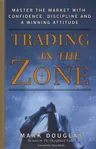
Trading in the Zone is Mark Douglas's book on the psychology of trading. This summary sets out its key ideas: the problem it tackles, how Douglas thinks about probability, edges and risk, what "the zone" refers to, and what a trader can do with those ideas. It's a guide to the ideas, not a chapter-by-chapter recap.
Educational content only. This page describes a book; it is not investment advice, and no book described here predicts or guarantees trading results. Trading carries risk of loss. TradingLoot doesn't claim to have read this book; this summary is built from the sources described below and listed under Book details.
Where this summary comes from
- The publisher, Penguin Random House, for what the book is about and the problem it addresses.
- The book's Google Books record, for a partial list of its section headings.
- Douglas in his own words: a 2002 interview with Larry Connors of TradingMarkets, in which Douglas said Trading in the Zone addresses how to think in probabilities "in great depth and detail." Points from that interview are what Douglas said in conversation, not quotations from the book, and this page presents them that way.
- TradingLoot's own synthesis, where we connect those ideas or turn them into practical steps. Those parts say so.
Trading in the Zone in one minute
- What it is: its publisher calls it a "concise guide to the psychology of trading." The current Prentice Hall Press edition is dated 2001 by the publisher.
- The problem: why traders get inconsistent results, and the ingrained mental habits that cost them money.
- The central idea: markets deal in probabilities, not certainties. The publisher says the book teaches traders to look beyond random outcomes and to be comfortable with the probabilities of market movement. Of the skills Douglas listed in a 2002 interview, he called learning to think in probabilities the most important.
- What it isn't: a strategy book. The publisher's description doesn't mention entry setups, indicators, or a trading system.
- The short version, in TradingLoot's words: judge yourself on how well you carry out a clearly defined edge over many trades, not on whether the last trade won.
The problem Douglas set out to solve
According to its publisher, Douglas "uncovers the underlying reasons for inconsistent trading errors" and helps readers overcome the ingrained mental habits that cost them money. In other words, the book is aimed less at finding trades and more at what goes wrong between knowing what to do and actually doing it.
Douglas explained that gap in his 2002 interview. Anyone can put on a winning trade without any skill at all, he said, and that early, easy success is exactly what fools people into thinking trading is easy. Producingconsistent results is a different matter: in his view it can be a lifelong learning process, and most of the skills involved are psychological.
The errors he had in mind are familiar ones: getting in too early or too late, skipping a valid signal, not placing a stop, moving it, or taking it out of the market. His point was that as long as a trader is prone to even one of these errors, good results over any stretch of time can be undone by a single trade.
The key ideas
The publisher's description and Douglas's 2002 statements point to the same handful of ideas. The book's Google Books record gives a partial, machine-extracted list of its section headings, including "Really Understanding Risk", "Perception and Risk", "The Market's Most Fundamental Characteristic", "Managing Expectations", "Eliminating the Emotional Risk", "Beliefs and Their Impact on Our Lives", "Thinking Like a Trader", "The Role of Self-Discipline", and "Self-Evaluation and Trading". That listing isn't a full table of contents, and this page doesn't describe what each section says.
Uncertainty is the starting point
The publisher frames the book around looking beyond random outcomes and understanding the probabilities of market movement. Douglas described the underlying puzzle in 2002: chart patterns do repeat, but the outcomes of those patterns don't. One reason he gave is that the people whose orders created the last pattern aren't the same people trading the one in front of you now, so an identical-looking setup can play out differently.
He also drew a line between understanding probability as a concept and actually thinking in probabilities while trading. Most traders, in his view, have the first and assume it gives them the second.
An edge is a probability, not a prediction
The publisher describes the book's approach as a mindset for "getting an edge on the market." Douglas's own definition of an edge, in the interview, was deliberately modest: "a higher probability of one thing happening over another." Nothing in that definition says the next trade will work.
He was equally clear that an edge has to be specific. The conditions that define it should be objective enough that the market, not the trader's mood, tells you it's there, and if those conditions aren't present, it isn't an edge.
Wins and losses arrive in random order
In the interview Douglas put it this way: "there is a random distribution between wins and losses on any given set of variables that define an edge." A genuine edge can still produce a run of losses, and nobody knows in advance which trades in a sequence will be the winners.
He tied this directly to trading errors. If a trader truly believes the outcome of any single trade is uncertain, he argued, there's no reason to jump in early, skip a signal or move a stop. Every error of that kind comes from one thought: "I think I know what's going to happen next."
One trade versus a series of trades
Because individual outcomes are uncertain, Douglas talked about an edge in terms of a series of trades rather than any single one. When he described how a trader could start building the skill, his advice was to work through a series of trades, doing exactly what the edge calls for each time.
TradingLoot's reading: a single trade tells you very little about either your method or yourself. The more useful questions are whether you followed the plan, and how the edge behaves over a meaningful number of trades.
Defining and accepting risk
The publisher says the book teaches traders "to understand the true realities of risk." Two of the headings in the Google Books record, "Really Understanding Risk" and "Eliminating the Emotional Risk", suggest the book treats risk as a psychological matter as well as a financial one.
In the interview, Douglas's practical version was to define your risk and your profit target before you enter. Asked whether the underlying problem is a need to be right, he agreed that a lot of it is, and traced what being wrong means to us back to how we grow up. His answer was to "take trading out of the 'right or wrong' context": a trade is about identifying an edge and acting on it, not about being proved right, so a stopped-out trade isn't a personal failure.
Beliefs, perception and self-sabotage
Headings such as "Perception and Risk" and "Beliefs and Their Impact on Our Lives" show that beliefs and perception have a central place in the book. In 2002 Douglas described one specific form this takes: even after a trader has a sound edge and thinks in probabilities, beliefs that conflict with their goals can still cause errors.
His example was self-worth. A trader whose sense of what they deserve hasn't kept pace with a rising account may, without realizing it, start making errors they had long since stopped making, even mechanical ones such as entering a buy instead of a sell. He saw internal conflict between what a trader wants and what they believe as the source of serious trading errors, and self-awareness, including keeping a journal, as the way to start noticing it.
How the ideas fit together
This is TradingLoot's reading of how the publisher's framing and Douglas's 2002 statements connect. It isn't the book's own outline.
- Markets are uncertain, so any single trade can lose, however good the setup.
- An edge is therefore a probability, and it only shows itself over a series of trades.
- Once that's accepted, a loss isn't proof you were wrong, and the risk was defined before you entered.
- With less riding on any one trade, there's less internal conflict to cause hesitation, early exits or moved stops.
- Carrying out the edge consistently, without that conflict, is the state Douglas describes as the goal, which is as close as the evidence gets to what "the zone" means.
Douglas made the same priority clear in 2002. Asked whether self-sabotaging beliefs were the most important issue, he said no: thinking in probabilities was, because once that is in place, a lot of the rest falls into place too.
What "trading in the zone" means
The publisher's description promises that readers will learn to "leverage the power of the 'zone'," but it doesn't define the term, and TradingLoot can't confirm how the book itself does.
What we do have is how Douglas described the ideal trading state of mind in 2002: "relaxed, basically carefree." He was specific about what carefree meant: free of internal conflicts that stop a trader doing exactly what they need to do, when they need to do it, "without hesitation, without reservation."
He set that against euphoria. Everyone, he said, has a threshold where normal confidence tips into euphoria, and in that state a trader stops perceiving risk at all and becomes prone to large money-management errors. He agreed that a run of wins, which can come down to probability alone, can carry a trader across that line.
In short: on the evidence available, "the zone" points to calm, conflict-free execution, not to feeling invincible. Treat this as Douglas's 2002 description rather than the book's own definition.
Putting the ideas into practice
These steps are TradingLoot's practical translation of the ideas above. Two of them, a pre-trade checklist and grading every trade, are habits Douglas said in 2002 that he kept himself. The rest go beyond what he said, and none of them guarantees better results.
- Write your edge down in specific terms.List the conditions that must be present for a trade. If they aren't all there, there's no trade.
- Set your risk and target before you enter.Decide where you're wrong and where you'll take profit before the order goes in, and leave the stop alone afterwards.
- Use a checklist on every trade.Douglas said he kept a laminated checklist, like an airline pilot, and that the urge to skip it was itself a warning sign of conflict.
- Grade the execution, not the outcome.Douglas graded his entries, exits and profits from "A" to "E" on every trade. A simple version: record whether you followed the plan separately from whether the trade made money.
- Review in batches, not trade by trade.Decide in advance how many trades you'll take before judging the edge or your execution, and look at the batch as a whole.
- Watch for euphoria after a winning run.Wanting to increase size or bend a rule after several wins is the moment to slow down, not speed up.
A trading journal makes the grading and batch reviews practical. To choose one, see Trading Journal Software Compared.
Possible misreadings
These are ways the book's ideas could be misread, as TradingLoot sees it, each checked against what Douglas said publicly.
- "Thinking in probabilities means rules don't matter."
- The opposite. Douglas insisted that an edge be specific and objective, with risk and target set in advance.
- "Being in the zone means feeling confident."
- Douglas separated a calm, conflict-free state from euphoria, which he treated as a danger, not a goal.
- "Losses don't matter, because outcomes are random."
- A single loss says little on its own. But the randomness applies within a real edge; it isn't a reason to keep trading an approach that shows no edge over a meaningful sample. That last point is TradingLoot's caution.
- "The right mindset replaces a method."
- Douglas listed learning to read the market and recognize an edge as a separate skill from the mental ones. The book works on how you trade an edge, not on finding one.
- "You have to trade mechanically forever."
- Douglas said that once a trader has built these skills and resolved the conflicts, they can trade as subjectively and intuitively as they want.
What the book doesn't teach
The publisher presents it as a psychology book, and its description doesn't mention entry setups, indicators, chart patterns or a ready-made trading system. Readers looking for those should pair it with a book on technical analysis or a specific method; TradingLoot's technical analysis books page groups some options by what they teach.
Who it's for
This is TradingLoot's guidance, based on the publisher's description and Douglas's stated views.
Likely to suit
- Traders who already have a method but whose results are inconsistent.
- Traders who hesitate, move stops, or break their rules after a loss or a winning streak.
- Anyone who wants a probability-based way to think about individual wins and losses.
May not need it yet
- Readers looking for entry setups, indicators, or a trading system.
- Complete beginners without any defined approach yet. Douglas treated finding an edge as its own skill, so the book's ideas may be most useful once there's an edge to execute.
Key takeaways
- An edge is a higher probability, not a prediction about the next trade.
- Within an edge, wins and losses arrive in random order, so judge a series of trades, not one.
- Douglas traced execution errors to acting as if you know what will happen next.
- Define your risk before entry, and take trading out of the right-or-wrong frame.
- Beliefs that conflict with your goals can cause errors; a journal helps you notice them.
- The state to aim for is calm and free of conflict, not euphoric.
Trading in the Zone and The Disciplined Trader
The Disciplined Trader came first. Its publisher dates it April 1, 1990 and credits it to Mark Douglas and Paula T. Webb. Trading in the Zone followed in 2001, credited by its publisher to Mark Douglas.
The author note on Trading in the Zone's publisher page describes The Disciplined Trader as "considered an industry classic and one of the first books to introduce the investment industry to the concept of trading psychology." Its own publisher describes it as offering "a step-by-step process" for understanding how your thoughts affect your trading results, for readers ranging from those new to trading to veteran traders. A partial Google Books contents listing for it includes "Why a New Thinking Methodology?" and "The Nature of the Trading Environment."
The publisher's description says the book is "now updated for today's traders and investors," and Paula T. Webb's site describes a revised second edition. TradingLoot hasn't confirmed that edition's date or ISBN, so the details below show the edition the publisher lists.
Which to start with
This is TradingLoot's guidance. Going by how their publishers describe them, Trading in the Zone is framed as a concise guide built around probabilities and risk, while The Disciplined Trader is framed as a step-by-step look at beliefs and how thoughts affect results. If the probability framing is what you want, start with Trading in the Zone; if you want the belief-focused approach, start with The Disciplined Trader. Both are by Douglas, so expect some shared ground; TradingLoot hasn't assessed how much the two books overlap.
About Mark Douglas
According to the author note on Trading in the Zone's publisher page, Douglas began coaching traders in 1982 and developed seminar and training programs on trading psychology.
Related book summaries

The Mental Game of Trading summary
Jared Tendler
A process for tracing a recurring emotional mistake to its cause, for when a reaction keeps overriding probabilistic thinking.

Encyclopedia of Chart Patterns summary
Thomas N. Bulkowski
Measures how chart patterns perform and fail, which puts numbers on the idea that an edge is a probability, not a prediction.
Related TradingLoot resources
- Trading Psychology Books: more books grouped by the problem they address.
- Trading Journal Software Compared: tools for grading and reviewing your trades.
- All book guides.
Book details
TradingLoot doesn't claim a first-hand reading of either book. Each book's details below say what its description is based on.
How this page was sourced
Sources were checked in October 2026. Book facts and descriptions come from the publishers' own pages first. The section headings come from Google Books records and are labelled as partial. Douglas's own views come from the edited transcript of his 2002 interview with Larry Connors, published by TradingMarkets; every quotation from it was checked word for word against that transcript, and none of it is presented as text from the book. Paula T. Webb's site is used only for the revised-edition note. Retailer listings, book-summary sites and unofficial copies of the book aren't used. Each source is listed in the book details above. See our Methodology for how we research and verify.
